
Revolving credit is a type of credit that allows you to borrow money, repay it, and borrow again up to a set limit. (Ex. Credit Cards)
Instalment credit is a type of loan where you borrow a fixed amount of money and repay it over time through regular, scheduled payments. (Ex. Car Loans)
Open credit is a type of credit where you’re required to pay the full balance owed in full each billing cycle. (Ex. Utilities)
Lenders use credit reporting agencies to determine a borrower’s loan repayment ability.
In Canada, Equifax and TransUnion are the two primary credit bureaus. Because they operate independently and do not share data, your credit profile can vary significantly between the two depending on which one a lender chooses to use.
Reporting is One-Way: Credit issuers (like Big Banks, Visa, or Rogers) are responsible for sending updates to the bureaus.
No Active Searching: Bureaus don’t “hunt” for your data; they simply archive what is sent to them.
The Single-Bank Trap: If all your accounts are with one bank, and that bank only reports to Equifax, you will have no credit history at TransUnion.
Relying on a single financial institution can inadvertently limit your future borrowing options. If a new lender pulls a report from the bureau your bank doesn’t use, you might appear to have no credit history at all. This is why financial experts suggest spreading your accounts across different institutions to ensure a robust presence at both agencies.
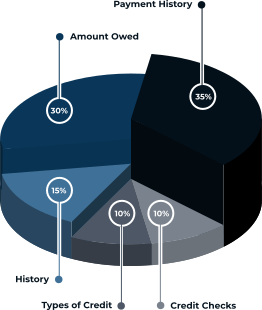
Payment history is the most important factor in your credit score because it shows lenders how you have previously managed your debts. A history of consistently late or missed payments can make getting approved for a loan difficult and may result in higher interest rates.
Amount owed or credit utilization ratio is the second most important factor in your credit score. To calculate it, add up the credit limits for all your credit products and divide by the total amount of debt you owe. This number represents how much of your available credit you’re actually using.
Lenders see high credit utilization ratios as a sign of risk, even if you always pay your balance in full and on time.
The length of your credit history is an important factor in your credit score. It’s generally good to keep your older accounts open and active. That said, there may be a time when it’s worth closing an older account. For example, if you have a credit card with an annual fee that you no longer use, it may make sense to close the account.
Having multiple types of credit products is generally better for your score than only having one. This shows that you can handle different types of credit responsibly. For example, having both a credit card and an auto loan can show that you can manage both revolving and installment debt. Additionally, having a mix of revolving and installment debt from different institutions can help establish your credit on both credit reporting agencies.
Inquiries are recorded on your credit report whenever a lender or other party requests your credit report from a credit reporting agency. While it’s normal and expected to seek credit every so often, too many inquiries on your credit report can cause concern among lenders. It might appear that you’re desperately seeking credit or trying to spend beyond your means without the ability to repay the money you want to borrow.
In Canada, your credit score is a three-digit number ranging from 300 to 900 that acts as a financial grade for your reliability as a borrower.
Because Equifax and TransUnion use different proprietary formulas—and because lenders often report data to them at different times—it is perfectly normal for your scores to vary between the two agencies.
While every lender sets its own rules, the score you carry directly impacts your borrowing power:
The Minimums: For a standard mortgage, most traditional banks look for a score of at least 680. If you have a down payment of less than 20%, you may qualify with a score as low as 600 through mortgage insurance (like CMHC), though the bank may still have stricter internal requirements.
The Prime Advantage: Scores above 760 are considered “excellent.” Reaching this tier unlocks the lowest possible interest rates and can qualify you for larger mortgage amounts, potentially saving you tens of thousands of dollars over the life of your loan.
Alternative Options: If your score falls below 600, you aren’t necessarily out of luck, but you may need to work with alternative or private lenders who charge higher rates to offset the risk.
Your credit score is a snapshot in time, not a permanent label. Speaking with a mortgage professional well before you start house hunting allows you to identify potential “red flags” and take steps to polish your report. This proactive approach ensures a smoother approval process and keeps your interest costs as low as possible.

Credit Recovery Needed

May Require a Larger Down Payment

Minimum Score for Most Lenders

Competitive Mortgage Options

Qualify For Best Mortgage Options

Highest Tier
Check out all of our frequently asked questions here
A credit score is a number (typically 300–900 in Canada) that represents your creditworthiness. Lenders use it to see how likely you are to repay loans on time. The higher your score, the better your chances of getting favorable mortgage rates.
Your credit score helps lenders determine:
Interest rate you qualify for
Mortgage approval odds
Down payment or insurance requirements
Higher scores often mean lower rates and fewer restrictions, while lower scores may require higher down payments or additional documentation.
Factors include:
Payment history – Paying bills on time
Credit utilization – How much of your available credit you’re using
Credit history length – Longer, responsible history helps
Types of credit – Loans, credit cards, lines of credit
Recent inquiries – Multiple applications in a short period can lower your score
Excellent: 750+ → Best rates and terms
Very Good: 720–749 → Strong approval chances
Good: 650–719 → Moderate approval; may need higher down payment
Fair: 600–649 → Approval possible, higher rates, or mortgage insurance required
Poor: <600 → Harder to qualify; options are limited
Pay bills on time and in full
Reduce high credit card balances
Avoid opening multiple credit accounts at once
Check your credit report for errors and dispute mistakes
Keep older accounts open to maintain a long credit history
It’s a good idea to check your credit at least once a year.
Soft inquiries (checking your own credit) do not affect your score.
Hard inquiries (lenders checking your credit for a mortgage) may lower it slightly, but multiple mortgage inquiries within a 14–45 day window are usually treated as one inquiry to minimize impact.
High credit scores → Better rates, lower insurance, more lender options
Moderate credit → May require higher down payment or insurance
Low credit → May need a co-signer, alternative lender, or specialized mortgage programs
Getting Pre-Approved is as easy as 1-2-3 with our online application
M Factory
Professional
Unbiased
Hybrid
Inclusive
Our Vision
Culture
Mortgages for Home Buyers
First-Time Buyer
Multi-Unit
Rental
Build-In extra funds
Sweet Equity
Save Interest
Custom Build
Turn-Key
Mortgages for Homeowners
Multiple Lenders
More Options
Save Money
Access Equity
Consolidate
Spousal Buyout
Access Equity
No Monthly Payments
Resources
Latest Mortgage News
Rate Updates...
Banks
Mortgage Lenders
Credit Unions...
Down Payment Calculator
Mortgage Calculator...
Credit 101
Glossary
FAQ...